
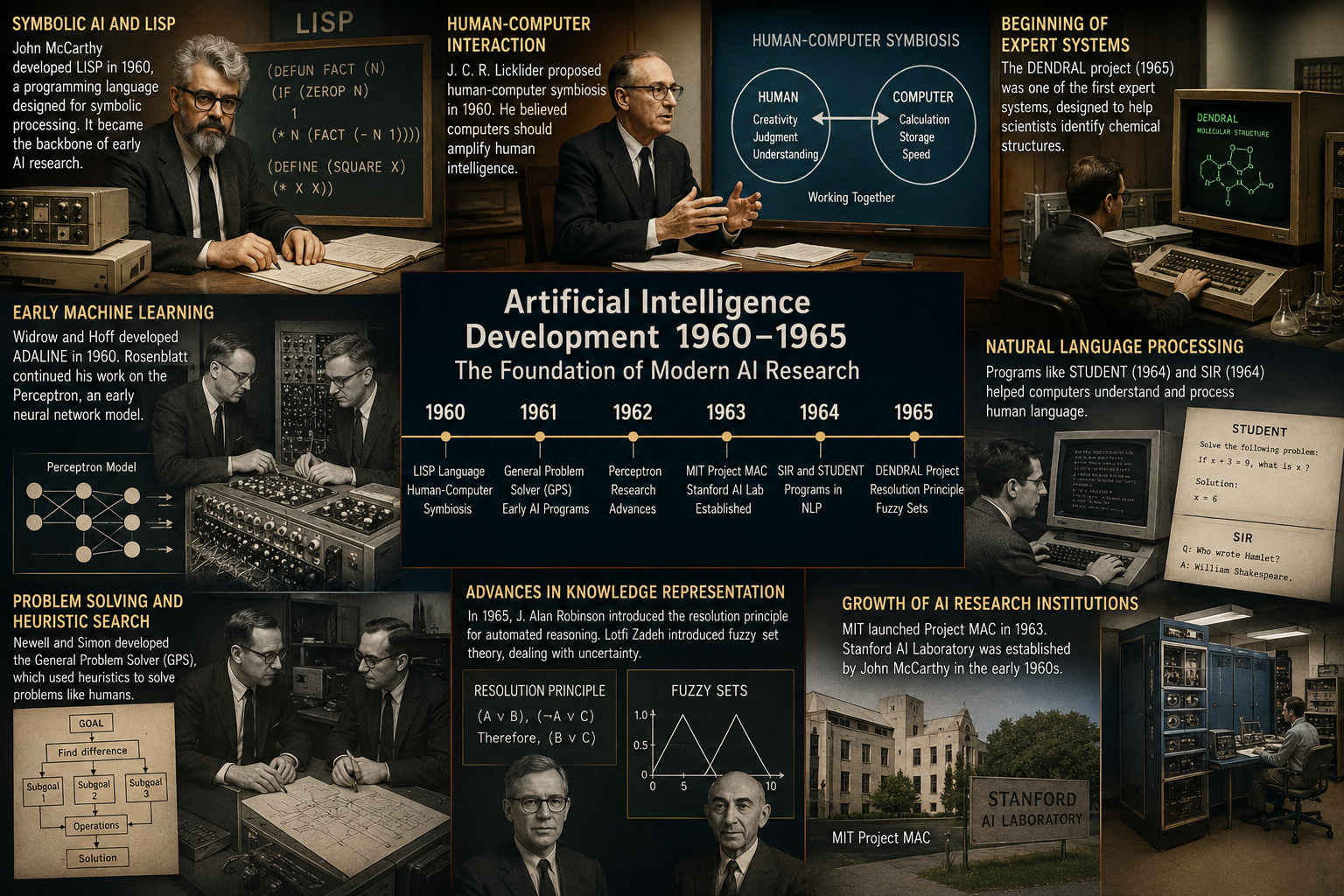
Artificial Intelligence Development from 1960 to 1965: The Foundation of Modern AI Research
Introduction The period from 1960 to 1965 was a turning point in the history of artificial intelligence. During these years, AI evolved from a promising idea into a serious field of scientific research. Instead of asking whether machines could think, researchers focused on building systems that could solve problems, learn from experience, understand language, and assist people in practical tasks. Many of the concepts developed during this period continue to influence modern artificial intelligence. Development of Symbolic Artificial Intelligence and LISP John McCarthy made one of the most important contributions to AI during this period. In 1960, he introduced the ideas behind the LISP programming language, which was created specifically for artificial intelligence research. Unlike conventional programming languages, LISP was designed to work with symbols and logical expressions, making it ideal for solving AI problems. It quickly became the preferred language in leading research institutions such as MIT and Stanford and remained widely used for many years. Human-Computer Interaction Another major milestone came from J. C. R. Licklider, who proposed the concept of human-computer symbiosis. He believed that computers should support human intelligence rather than replace it. According to Licklider, people are naturally better at creativity, judgment, and decision-making, while computers excel at calculations, speed, and storing information. His ideas shaped the future of interactive computing and inspired many later developments in artificial intelligence. Early Machine Learning Researchers also began investigating whether computers could learn from experience. Bernard Widrow and Marcian Hoff developed the ADALINE learning system, which allowed computers to improve their performance by adjusting their responses after making mistakes. At the same time, Frank Rosenblatt continued developing the Perceptron, an early neural network model capable of recognizing patterns from examples. Although limited by the technology of the time, his research became an important foundation for modern machine learning and deep learning. Problem Solving and Heuristic Search One of the main goals of AI research during this period was teaching computers to solve problems. Allen Newell and Herbert Simon developed the General Problem Solver, a program designed to imitate human reasoning by breaking difficult problems into smaller, manageable steps. It used heuristic methods, allowing the computer to search for efficient solutions instead of examining every possible option. James Slagle also introduced SAINT, a program capable of solving symbolic mathematics problems. These developments showed that computers could perform logical reasoning beyond simple numerical calculations. Natural Language Processing Researchers made important progress in enabling computers to understand human language. Daniel Bobrow developed STUDENT, a program that solved simple algebra problems written in English. Bertram Raphael created SIR, which answered questions using stored knowledge. Meanwhile, Yehoshua Bar-Hillel emphasized that language translation required understanding meaning and context, not simply replacing words. These studies became the foundation of modern natural language processing. Growth of AI Research The early 1960s also witnessed rapid growth in AI research institutions. MIT established Project MAC, while John McCarthy founded the Stanford Artificial Intelligence Laboratory. At the same time, financial support from the Advanced Research Projects Agency helped researchers gain access to better computers and larger research facilities. This support accelerated progress and encouraged collaboration between scientists. Advances in Knowledge Representation Important theoretical advances were also made during this period. In 1965, J. Alan Robinson introduced the resolution principle, providing a more effective method for automated logical reasoning. During the same year, Lotfi Zadeh introduced fuzzy set theory, allowing computers to handle uncertainty instead of relying only on strict true-or-false decisions. Both contributions later became essential in many areas of artificial intelligence. Beginning of Expert Systems